


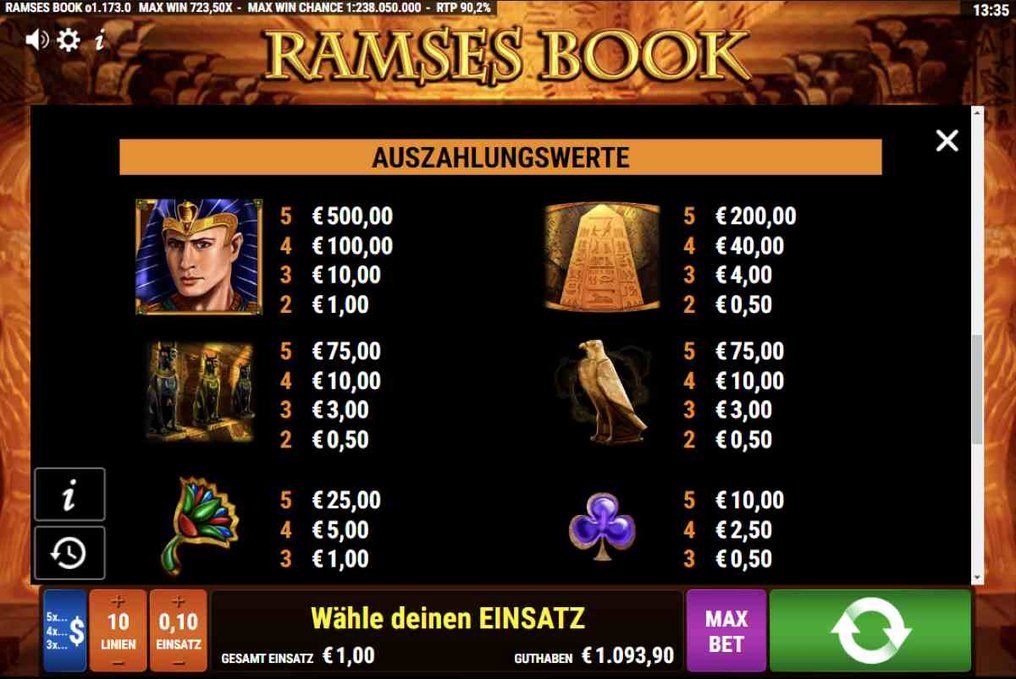
Learn to log in, try the demo and set limits, so you can play Ramses Book in The Netherlands at your own pace.
Imagine: you want a short session after work, but you don't feel like clicking through twenty menus or learning new rules. Then a recognizable theme and a clear game rhythm are exactly what you're looking for. Many players therefore choose Ramses Book: you quickly understand what's happening, and you can decide for yourself how intense you make it.
What attracts people to these kinds of Egyptian adventure games? Usually, it's a combination of simple controls and layered excitement. You start with regular spins, you see symbols that quickly become clear, and you soon notice if you like the flow. That makes it accessible, even if you don't play every week.
However, the real gain for your enjoyment isn't in 'trying more', but in 'planning better'. Anyone who chooses a session goal beforehand (testing, relaxing, or a short adrenaline round) is less likely to fall into that familiar trap: continuing to play because you just want to grab 'one more moment'. In 2026, with fast mobile sessions and constant distractions, that difference is greater than ever.
All promotional incentive structure is clearly stated in writing and/or via electronic means in an easily understood manner. All codes are accompanied by an explanation of what the code is for, who is eligible to use the code, and how it should be used. As such, players are less likely to be confused about what is required of them in order to receive a reward and how the reward will be applied after receiving it. The promotional incentives provided to participants provide them with time to become familiar with the gaming system's mechanics, their interface, and progress, before deciding how deeply they wish to become involved with this platform. Therefore, players are encouraged to participate in an informed manner, rather than being pressured or tempted to act quickly.
Imagine: you're sitting on the couch, phone in hand, and you think you only have ten minutes. Then a message comes in, you look away for a moment, and suddenly half an hour has passed. That doesn't happen because you lack discipline, but because a game doesn't have an inherent end. So you have to design that end yourself.
If you play Ramses Book in The Netherlands, you'll enjoy it most if you use two types of limits: time and budget. Time is your timer. Budget is an amount you can truly afford to lose without regretting it later. If you tell yourself 'we'll see', it almost always goes wrong the moment things get exciting.
Make it concrete with a small plan: one session, one budget, one stopping point. You don't need to build a complicated strategy. For example, choose a session duration of 15-30 minutes and start your timer immediately. Also decide beforehand what you'll do if you get frustrated: don't click faster, but instead pause or finish. That way, it remains entertainment, not an emotional discussion with yourself.
And yes, these types of games are intended for adults and should be played within the rules applicable in The Netherlands. Don't say that as a formality, but as a practical agreement: if you can't play relaxed, don't play.
Imagine: you finally have a quiet moment, you want to start, and exactly then you can't remember your password or your screen keeps loading. Many players then try hastily, click too many times, and end up with extra hassle. A fixed login routine makes everything simpler: you stay calm, you work step by step, and you start your session with control.
Start with the basics. Choose your device (mobile or desktop), ensure a stable connection, and only log in when you can neatly enter your details. Once you're in, don't spin immediately. First, check your settings: limits, breaks, and where to find help if something gets stuck. That minute of preparation prevents you from having to stop mid-session later to fix something.
Also, consider tempo. Logging in on mobile is faster, but that also makes you tap faster. If you notice you're already rushed during registration, that's a signal to pause for a moment. Your session doesn't start with the first spin, but with your first click.
Imagine: you switch between phone and laptop, and each time it feels like you have to search again for where everything is. That makes you restless, and restlessness often leads to impulse. Therefore, choose one 'main device' for longer sessions and one device for short moments, so your routine remains recognizable.
On mobile, it helps to close background apps and limit notifications. Not because you 'have to', but because you have fewer distractions while playing. On desktop, you can often plan more calmly: set a timer, make a note of your budget, and a clear stopping point. The goal is the same: you don't want to make up your rules as you go.
A simple habit works surprisingly well: after logging in, do nothing for five seconds. Look at your balance, look at your timer, and check if you still want to play. That short pause takes you out of autopilot.
Imagine: you're in a hurry, you think your password is 'almost right', and you try it three more times. After that, you're locked out and only get more irritated. The calm route is faster: recover once, complete the process, and only then proceed.
Use recovery step by step. Check that your keyboard language is correct, pay attention to spaces, and don't let autocorrect hijack your input. Request one recovery code, wait, use that code once, and then create a new password that you remember without carelessly saving it anywhere. Store recovery data securely so you don't end up in that stress again later.
If you're back in after recovery, don't start with a long session. First, do a short, calm round and immediately check your limits. This prevents frustration from the login moment from influencing your playing behavior.
Common Login Problems and Quick Fixes
Sometimes the problem isn't your account, but your session. Think of a page that keeps loading, a screen that refreshes, or an app environment that responds sluggishly. The best approach is boring but effective: close everything completely, reopen, and check your connection before trying again.
Stick to one rule: don't change ten things at once. Don't immediately switch devices AND networks AND settings. Start with one step, for example, restarting, and see if it's resolved. If you change everything at once, you'll never know what worked and you'll keep going in circles.
When It's Better to Take a Break
If you notice yourself clicking faster, sighing harder, or getting angry at small notifications, that's the moment to stop troubleshooting and take a break. Technology that falters feels personal, but it isn't. Take a minute away, come back with a clear head, and then pick it up again.
Imagine: you deposit an amount that 'is fine', you play for a while, and then you want to deposit more because you've just had a losing streak. That's exactly how a short session becomes a long session. The problem isn't with money, but with the lack of a firm agreement with yourself.
Make your session budget small and clear. One session means one starting budget. When the budget is gone, the session is over. Want to play again later? Then start a new session with a new timer. This feels strict, but it provides peace of mind. You don't have to negotiate with yourself in the heat of the moment.
Withdrawing works best as a routine, not as 'later is fine'. If you want to protect your winnings, choose a threshold beforehand at which you will finish. After that, take a break and only then decide whether to withdraw or stop. Processing can vary by method and sometimes additional steps are needed. That's normal, as long as you don't act in a panic.
|
Section |
What You Set |
Why This Helps |
Practical Tip |
|
Session time |
15-30 minute timer |
Breaks 'just one more' |
Set the timer before you start |
|
Session budget |
Fixed amount per session |
Prevents topping up on emotion |
One session is one budget |
|
Loss limit |
Stop at pre-chosen minimum |
Protects your evening |
No discussion after the signal |
|
Profit limit |
Conclude at a satisfactory profit |
Keeps profit truly profit |
Pause before you decide |
|
Pause moments |
Short stop every 5-10 minutes |
Takes you out of autopilot |
60 seconds is enough |
|
Support path |
Know where help is |
Less stress with issues |
Note what you see on the screen |
Imagine: you choose the fastest option because it's easy, and then you notice that you're more inclined to deposit again. Then that method doesn't suit your playing style. So don't just choose based on speed, but on how you react.
If you are susceptible to impulse, a little friction helps. Not to annoy you, but to give you an extra moment to decide. If you mainly want an overview, choose a method that allows you to clearly track your transactions. The goal is for you to remain calm, not for everything to go as fast as possible.
Make this choice at a calm moment, not in the middle of a session. Changing in the moment is often emotion. And emotion is expensive.
Imagine: you're in a moderate flow and you think 'I'll just top up, and it'll be fine.' That's not a plan, that's a reflex. With one deposit per session, you remove that reflex from the game because the agreement is already set.
This rule works especially well on mobile. Mobile playing pace is higher, and topping up therefore feels 'logical' faster. By limiting yourself to one starting budget, you make your sessions shorter, clearer, and calmer. You also notice faster whether you truly want to play today or if you're actually mainly looking for distraction.
If you find yourself often running up against this rule, lower your session budget and make your sessions shorter. Less room means less chance of impulse.
Imagine: you see a nice profit and you think 'later,' but later another session comes and you give it back. Many players lose profit due to procrastination, not bad luck. That's why a fixed routine works better than good intentions.
Choose a profit limit that satisfies you and treat it as an endpoint. If you hit that limit, you conclude, take a break, and decide with a clear head. If processing or verification takes some time, remain calm. Restlessness only makes you more inclined to keep playing, and that's precisely what you wanted to prevent.

Imagine: you start relaxed, but after a few near misses, you start clicking faster, and suddenly it feels like the game is playing you. This often happens because the pace invisibly increases. In 2026, with fast interfaces, pace is a setting you must actively monitor.
The best approach is not “trying harder,” but “dosing smarter.” Work with blocks: a starting block to get into it, a middle block for stable play, an end block to wind down. In the end block, you change nothing more: no new plans, no quick increases. You conclude.
Also, pay attention to your own triggers. Some players increase their bets after a win, others after a loss, still others after a near-bonus. Recognize your pattern and put a brake on it: pause as soon as you feel it. A short stop is often enough to choose rationally again.
Imagine: you say beforehand that you'll stay calm, but after three less-than-stellar spins, you think, “just one step higher.” That's precisely how a stable session turns into an emotional one. The solution is simple: you choose your bet before you start and you stick with it.
Choose a bet that suits your session duration and budget. If you want to play for 20 minutes, your bet should allow for that, even if things go poorly. If you want to play short and intensely, that comes with a smaller number of spins and a firm stopping point. Make it measurable: “I play for a maximum of X minutes” or “I stop after Y spins”.
And if you do want to change, only do so according to a pre-chosen rule, not because of a sudden feeling.
Imagine: you think “I'll pause later,” but later never comes because it's always just exciting. That's why planned breaks work better than breaks based on feeling. Set a timer or agree on fixed times.
A break doesn't have to be long. One minute is enough: breathe calmly, look at your timer, check your balance, and ask yourself if you're still playing according to plan. If the answer is no, you wrap up. If the answer is yes, you continue calmly. This small check prevents you from ending up in a tunnel.
For many players, it helps to link breaks to a fixed action, such as drinking water. It sounds simple, but it makes pausing a reflex.
Imagine: you're curious, but you don't want to immediately bet money without knowing how it feels. Then testing is a smart start. You not only learn the buttons, you also learn yourself: how do I react to a long silence, to small hits, to tension?
Use testing to find your pace. Play calmly for a few minutes, notice how often you're inclined to click faster, and then adjust your session plan. If you notice you're already restless after five minutes, make your sessions shorter and your budget smaller. If you remain calm, you can carefully scale up later, but always with the same structure.
Testing is also useful for checking your settings: sound, notifications, breaks, and limits. These are not extras; they are your controls.
Imagine: you feel irritation after every spin, but you don't want to stop because you've “just started.” That's the moment when winding down saves your session. Winding down means: pace down, no more changes, concluding.
Signals are clear if you dare to see them: you ignore your timer, you think about “getting back at it,” or you feel yourself clicking faster to suppress the feeling. In such moments, one simple rule helps: emotion up, pace down. And if that's not enough, take a time-out.
A proper conclusion is often the difference between a good evening and an evening you regret later.
Imagine: something gets stuck, and you think you have to solve it yourself, even though you're already stressed. Many players wait too long to contact support and make the problem bigger by trying too much. Support is there to give you an overview again, so you don't play out of frustration.
Communicate factually: what did you want to do, what happened, and what message did you see? Keep it short. And don't keep playing to suppress impatience. If you notice your behavior changing, choose to pause. Responsible gaming in Netherlands practically means: staying within the rules, only playing when you have the mental space for it, and taking your own limits seriously.
Concluding is a skill. You conclude at a good moment, not just when you're empty. You check your balance, you note for yourself whether you kept your limits, and you end the session. If staying automatically logged in triggers you to return, consciously log out. Small steps, big effect.
Imagine: you stop because you're tired, but your mind is still in the game. Then there's a good chance you'll open it again later “for a few spins.” Smart concluding means helping your brain truly stop.
Create a short end-of-session ritual: timer off, screen closed, do something else. When you return later, don't start out of habit, but with a plan: new budget, new timer, the same calm pace. This way, Ramses Book remains a form of relaxation and not an endless loop.
And if you notice that playing too often becomes your standard relaxation, then consciously plan a longer break. Not as a punishment, but as a reset.
Take one minute before you start: choose a stable network, check your keyboard language, and consciously type in your details without rushing. Imagine you're on the go and your thumb is faster than your head - then the chance of a typo is high. After logging in, wait five seconds, check your limits, and only then start your session. This short routine prevents a lot of frustration.
Use recovery step by step and avoid guessing with multiple attempts in a row. Request one code, wait calmly, complete the process, and then choose a new password that you can remember. If you notice yourself getting irritated, put your phone away for a moment and come back with a clear head. After recovery, start with a short session so you don't continue playing out of stress.
On mobile, you tap with your thumb, and that pace is often higher than with a mouse. Imagine sitting on the couch and automatically tapping away while also reading messages - then control decreases. Therefore, make mobile sessions shorter, use a timer, and keep your bet stable. On desktop, you can plan more calmly with fixed blocks and breaks.
Choose an amount that you can miss without regret, even if the session goes poorly. Imagine that afterwards you think “this was too much” - then the budget was too high for your feeling, not necessarily for your wallet. Make the budget per session smaller than your instinct tells you and link it to a timer. One session is one budget, without topping up based on emotion.
Plan breaks in advance instead of waiting until you “feel like it”. Set a reminder for every 5-10 minutes and pause for at least one minute to check your balance and timer. If you notice yourself clicking faster or thinking about getting back what you lost, that's exactly when you should stop. Breaks are not an interruption of fun, they protect it.
Work with a pre-chosen profit limit and treat it as the end point of your session. Imagine you're just satisfied but still continue “to make it bigger” - then you often give back what you had. Finish up, take a break, and only then decide if you want to play again later. This way, profit remains a positive moment and not fuel for impulse.
If you notice yourself returning out of habit, irritation, or the urge to compensate for losses, a longer break is often better than another session. Imagine you start “just for a moment” every evening and it keeps dragging on - then your pattern is the problem, not the game. Use time-outs as a reset and only come back when you can start again with a clear plan.
Ramses Book is a fascinating game that combines the best of online slots with an exotic and exciting theme.